We rebuild how your business runs and how it wins customers.
Most of the companies that come to us believe they have a growth problem, when what they
actually have is an operating problem that happens to show up in the sales numbers. We
work on how the work moves through your business and on how demand arrives at it, in
that order, and then we hand the whole thing back to you written down.
Every price is published
You get documents, not slideware
You keep everything we build
Process and ownership
Every recurring job in your business gets one owner, one written standard and one place where it lives.
Margin and pricing
We find where the money is leaking between the quote, the delivery and the invoice, and then close the gap.
Demand and funnel
We find the positioning a buyer can repeat back to you, and then build the channels that carry it.
Measurement
You end up with a single page of numbers that you will actually read on a Monday morning.
Two pillars
We work on the two things that decide whether a company survives its own growth.
Operations and marketing usually get treated as separate departments with separate
consultants attached to them. In a business of under fifty people they are really the same
problem seen from two different ends, which is why we take both rather than picking one.
Business Operations
This is the work of making a company run without you sitting in the middle of every
decision. We map how work actually moves through the business, find the constraint that
is holding your output down, write the procedures that remove it, and then put a weekly
rhythm around the numbers so that you can see drift while it is still small.
This is the work of making demand predictable enough that you can plan around it. We
start with what you are genuinely the best choice for, price and package it so that it
argues for itself, and then build the two or three channels your buyer actually uses
rather than trying to be present everywhere at once.
There is a third and much smaller line of work. We mentor traders on
risk sizing, process and review discipline, which is education rather than advice, and we
keep it deliberately outside the two pillars above.
Read what it covers.
Business operations
If you are the bottleneck, nothing else you buy is going to work.
The pattern is usually recognisable from a long way off. Revenue climbs, headcount
climbs, and somehow you are answering more questions than you were a year ago. Quotes
sit waiting on one person, nobody is quite sure who owns the handover, and the margin
erodes quietly because the exceptions became the norm and nobody ever wrote them down.
We start by watching how the work actually moves rather than how the org chart says it
should, and then we cut the queue, put a name against every stage, write the standard
down and attach a number to it. The point of all that is simply that drift becomes
visible to you in the first week rather than in the third quarter.
We measure cycle time from first enquiry to cash before we change anything at all
You end up with the three decisions only you can make, and twenty you never see again
Your next hire can be trained from the procedure library on their first day
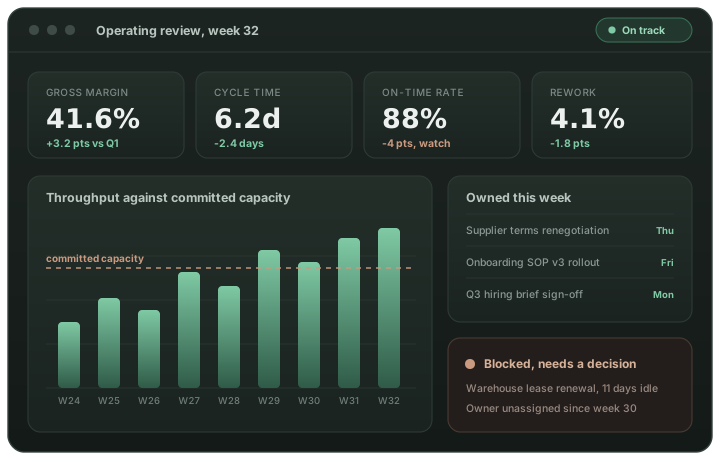
The weekly operating dashboard we build with you. It fits on one page, takes about five minutes to read, and nobody needs a login to understand it.
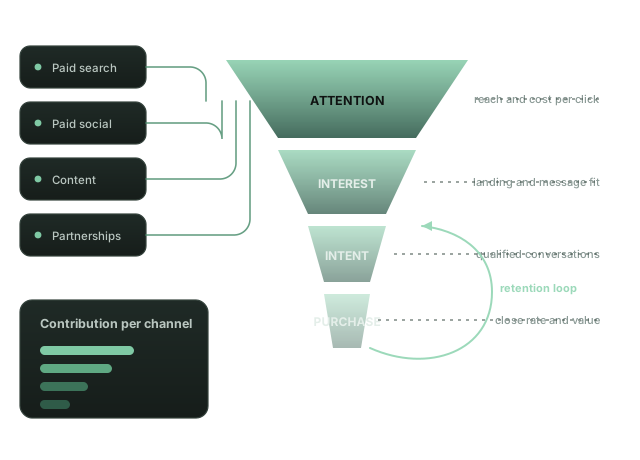
Every channel is judged on one number at one stage of the funnel, and any channel that cannot name its number does not get a budget line.
Marketing
Spending more is the last lever we pull, not the first one.
Before we go anywhere near a budget, we work out why anybody should choose you when a
cheaper option is one search away. That answer becomes your positioning, your offer,
your pricing page and the first line of every advert, and in our experience most of the
lift comes from getting that right rather than from the media plan that follows it.
After that we pick two or three channels your buyer genuinely uses, build the landing
pages and the follow-up properly, and hold each one to a single number. If a channel
cannot pay for itself inside the window we agreed at the start, we will tell you and
stop it, rather than quietly rolling the budget forward into next quarter.
Positioning tested against real buyer conversations rather than internal opinion
A ninety day plan giving every channel a budget, an owner and a judging metric
Retention work, because the cheapest customer you will win is the one you already have
There are four stages, and you can stop after any one of them.
Nothing here asks you to commit to twelve months before you have any idea whether we are
useful to you. The diagnostic stands on its own, and we have priced it so that it can.
STAGE 01
Intro call
We spend forty five minutes together and you describe the constraint as you see it. We will tell you plainly whether it is something we work on and roughly what it would cost.
Free, and there is no deck
STAGE 02
Diagnostic
We interview the people actually doing the work, read your numbers and map what is really happening, then give you findings ranked by what each one costs you every month.
Two to four weeks, fixed fee
STAGE 03
Build
We write the procedures, rebuild the pricing or set up the funnel, depending on where the diagnostic pointed, and we do it with your team in the room so that it survives our leaving.
Six to twelve weeks, fixed fee
STAGE 04
Partnership
Once the system exists you can keep us on monthly for a standing review, an outside opinion on the harder calls, and someone to hold the cadence when the week gets away from you.
Monthly, six month minimum
What you actually receive
You get documents your team uses on a Tuesday, not a deck that gets filed.
Every engagement produces things that stay useful long after we have stopped invoicing
you. They live in your systems, in your account, in formats you can edit, which means
there is no portal for you to lose access to and no licence for anybody to renew.
Written procedure libraryYour document system
One-page operating dashboardSpreadsheet or your BI tool
Ranked findings with monthly cost attachedDocument plus working file
Ninety day growth plan with budgetsDocument plus working file
Hiring briefs and role scorecardsEditable templates
Quarterly review pack templateSlides plus source data
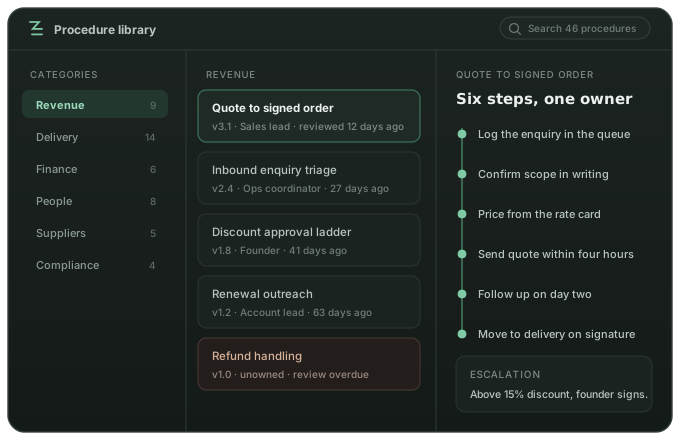
A procedure library with an owner, a version and a review date against every entry, where the overdue ones are meant to be visible rather than tucked away.
Third line of work
We teach trading as a discipline rather than as a source of tips.
This is a smaller part of what we do and we keep it that way deliberately. What we teach
is process: how to size your risk before you enter rather than afterwards, how to write
down in advance what would prove you wrong, how to keep a journal you will actually
reread, and how to review a month of your own decisions without quietly flattering
yourself in the process.
We do not sell signals, we do not manage anybody's money, and we make no claims at all
about returns. If what you are looking for is somebody to tell you what to buy, we are
the wrong firm for you, and we would far rather say that here than halfway through a
sales call.
Group cohort
A weekly group session with shared journal review, capped at twelve people
USD 520per month
One to one
Two private sessions every week, plus a written review of your journal
USD 1,400per month
Sixteen week intensive
The full programme, two sessions a week, with your risk framework built from scratch
USD 5,400one-time
Education only. ZZ Keys does not provide investment advice, does not
deal in or advise on securities or futures contracts, does not manage client funds and
is not licensed by the Securities and Futures Commission of Hong Kong. Trading carries
the risk of losing your capital.
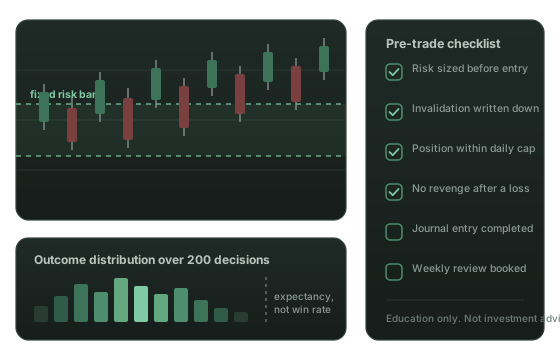
This is what the mentorship is actually about. The checklist on the right is the deliverable, and the chart on the left is only the thing it gets applied to.
What we commit to
These are the terms we hold ourselves to, published rather than negotiated.
3 wk
From kickoff to written diagnostic findings in your hands
1 pg
The operating dashboard fits on one page, or we built it wrong
100%
Of what we build is yours, in editable files, on the day we hand over
0%
Commission or kickback taken from any tool we recommend to you
ZZ Keys is a young firm, and we would rather publish the commitments we are prepared to be
held to than case studies that you have no real way of checking.
Pricing at a glance
Every engagement has a published price before you ever speak to us.
All the figures below are in US dollars and they exclude media and software spend, which
you pay directly to the vendor and keep control of. Fixed-fee work is invoiced half at the
start and half on handover.
Business operations
Operations Diagnostic
Three weeks. You get a process map, the constraint findings and a ranked list of fixes
USD 4,800fixed
Operating System Build
Ten to twelve weeks. Procedure library, owner map, dashboard and handover training
USD 16,500fixed
Operating partnership
Monthly, in three tiers running from a standing advisory to an embedded operator
from USD 3,600per month
Marketing
Growth Diagnostic and Positioning Sprint
Four weeks. Positioning, offer, a channel shortlist and a ninety day plan
USD 5,200fixed
Funnel Rebuild
Eight to ten weeks. Landing pages, lifecycle email, tracking and launch
USD 14,800fixed
Growth retainer
Monthly, in three tiers from a single channel focus to running the whole function
from USD 4,300per month
Trading mentorship
Mentorship programmes
The group cohort, one to one mentorship, or the sixteen week intensive
Your situation probably does not fit a tier on this page.
Most of the interesting work does not. It might be a carve-out, a founder stepping
back, a market entry into a new region, or two divisions pulling in opposite
directions. Tell us what is actually happening and we will price a scope against it
in writing, within three working days of the intro call.
These are the things people ask us on the first call.
Below roughly five people, the constraint is nearly always your own time, and a
fixed-fee consulting engagement is a poor use of money that would go a good deal
further on a hire. We will tell you that on the intro call rather than sell you a
diagnostic you do not need. Above that size the work usually starts paying for itself.
Both, depending on the stage you are at. Diagnostics benefit enormously from two or
three days in the building, watching handovers and sitting in on the meetings that
everybody complains about, whereas build and partnership work runs perfectly well
remotely. Travel is quoted at cost and agreed with you before anything gets booked.
Yes, and sometimes that is the right call. But if your delivery is already running at
capacity, more leads will only make the customer experience worse and the margin
thinner, so if we see that in the diagnostic we will say so before you spend anything
on media, even though the operations work is much the slower sale for us.
No, it is education on risk management, process and review discipline. We do not
recommend securities, we do not provide signals, we do not manage money, and we are
not licensed by the Securities and Futures Commission of Hong Kong. Nothing in the
programme should be treated as a recommendation to buy or sell anything at all.
Because the alternative is three calls before you find out whether we are affordable,
and that wastes your week just as much as it wastes ours. The published prices are the
real ones. A custom scope still gets a written quote, but it is built from the same day
rates rather than from a guess about what you might be able to pay.
You keep every document, template, dashboard and working file, in editable formats and
in your own accounts, and we run a handover session with the people who will be
maintaining it afterwards. If you never speak to us again the system still works,
which is the whole reason we build it this way.
Start here
Start by telling us what is actually broken.
It takes forty five minutes, there is no deck and there is no obligation at the end of it.
If we are not the right people for the problem you describe, we will say so and point you
towards somebody who is.