Positioning
We work out who you are the obvious choice for, and who you are deliberately not for, then test it against real buyer conversations rather than a workshop whiteboard.
Positioning comes first, then the offer, and then two or three channels that are each held to a single number. We would far rather cut a channel that cannot pay for itself than move its budget quietly into next quarter and hope nobody notices.
If a buyer cannot repeat back what you do and why it should be you rather than the cheaper option, no amount of impressions is going to fix that. We work in this order, and we do not skip ahead because a particular channel happens to be fashionable this year.
We work out who you are the obvious choice for, and who you are deliberately not for, then test it against real buyer conversations rather than a workshop whiteboard.
We look at how the thing is packaged, what is included, where the entry point sits and why the price is the price, which is usually the highest leverage change we make.
We shortlist the channels your buyer actually uses and give each one a budget, an owner and the single number it will be judged on. Two or three of them, rather than eight.
We build the landing pages and follow-up sequences, set up tracking that would survive an audit, and put in a review rhythm that kills whatever is not working on schedule.
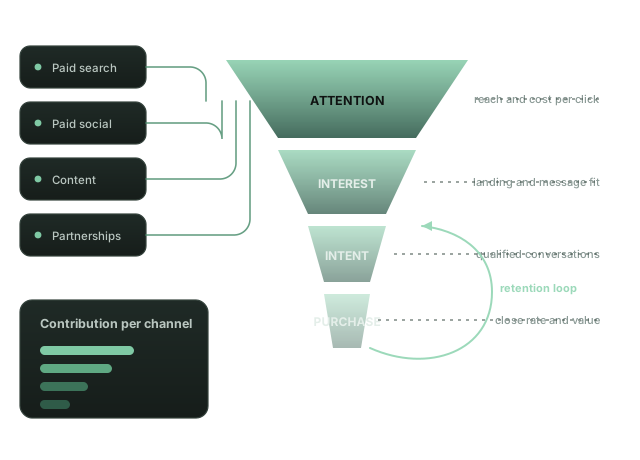
Marketing reporting falls apart when each channel is measured on whatever happens to flatter it. Paid search reports clicks, content reports impressions, email reports opens, and by the end of the quarter nobody can say what any of it actually produced. We assign every channel to a funnel stage and to the single number that stage is responsible for.
That is what makes the uncomfortable conversation possible later on. If partnerships were meant to produce sourced pipeline and produced none of it in ninety days, the channel goes and the budget moves to something that carried its weight, and because it was written down in advance that becomes a rule rather than an argument.
Both are invoiced half at the start and half on handover. Prices are in US dollars and they exclude media spend, which you pay directly to the platform and keep control of throughout the engagement.
For companies whose marketing is busy without compounding, and who suspect the message is the real problem.
Fixed fee. Four weeks from kickoff.
For companies with the positioning already settled who need the machine actually built and launched.
Fixed fee. Eight to ten weeks. Sprint fee credited if taken first.
There is a six month minimum, after which it runs monthly with thirty days notice. Media spend is separate and paid by you to the platform, and managing it is included up to USD 20,000 of monthly spend, then charged at twelve percent of anything above that.
One channel run properly, rather than four of them run badly at the same time.
One primary channel plus the pages it lands on.
Acquisition, conversion and retention held together by a single plan.
Up to three channels plus lifecycle and reporting.
For companies without a marketing lead, or in between two of them.
Senior ownership of the whole function.
On media spend. Your advertising accounts stay in your name, funded by your card, with you as the owner and us as a user you can remove whenever you like. We do not resell media, we take no rebates from the platforms, and we never mark up your spend.
Advertising accounts, analytics properties, email lists and domains all stay in your ownership throughout, and we work inside them as a user you can remove at any point. That is not a courtesy on our part, it is the only arrangement that leaves you genuinely free to change your mind about us.
It might be a product launch, entering a new region from elsewhere, repositioning after an acquisition, or selling something the market has no existing search demand for at all. Tell us the situation and we will price a scope in writing, within three working days of the intro call.
No, and we would treat anybody who does with a fair amount of suspicion. Too much of the outcome sits outside our control, including your pricing, your delivery capacity, your sales follow-up and your competitors. What we do commit to is the work, the cadence, and telling you early and plainly when something is not working rather than at the end of a quarter.
For paid channels, enough to get a readable signal inside a month, which for most business to business companies starts somewhere around USD 4,000 to 6,000 a month per channel. Below that you are mostly buying noise. If your budget is smaller than that we will usually point you at organic and lifecycle work first, which is slower but does not need a floor underneath it.
Yes. On Growth Command we manage them directly, which is often rather the point of that tier. On the lower tiers we set the strategy and the numbers they are held to and then stay out of their execution. We take no fee from any agency for referrals or for keeping them engaged with you.
We write the copy, the landing pages and the briefs, and we build the pages themselves. Design, video and photography are handled by your team or by a specialist you appoint, and we are very happy to brief and direct them. Their cost sits with you rather than being marked up on its way through us.
We will tell you before you commit to a retainer. Pouring demand into a delivery function that is already at capacity produces late work, refunds and a worse reputation than you started with, which is exactly what the operations side of the firm exists to prevent. The two are usually sequenced rather than run at once.
Forty five minutes on what you sell, who keeps saying no to it, and what you have already tried. We will tell you where the leverage actually sits.
We also run a much smaller trading mentorship covering risk and process discipline, which is education rather than advice. See what it covers.