Everything ends up waiting on one person
Quotes, approvals, exceptions and hiring all route back through you, holidays are largely theoretical, and the business grows to roughly the size of one person's inbox before it stops.
We map how the work actually moves through your company, find the constraint that is capping your output, write the procedures that remove it, and then put a weekly rhythm around the numbers so that drift shows up in days rather than in quarters.
These are the symptoms owners describe to us on the intro call, and underneath very nearly all of them sits the same small handful of structural causes.
Quotes, approvals, exceptions and hiring all route back through you, holidays are largely theoretical, and the business grows to roughly the size of one person's inbox before it stops.
Nobody can say with any confidence which jobs, clients or product lines actually make money once the delivery time is counted honestly, so the unprofitable work quietly keeps getting sold.
There is nothing written down, so training happens by shadowing and quality depends on whoever did the teaching, while the good people carry the extra load and start looking around.
A recurring decision gets relitigated because it was never written into a standard, so the answer changes depending on who happens to be in the room and how tired everybody is that week.
The numbers land six weeks after the month they describe, which means that by the time a problem becomes visible in a report you have generally paid for it at least twice already.
Sales keeps selling and operations keeps absorbing, the buffer disappeared some time last year, and every new client you win is now quietly a risk to one you already have.
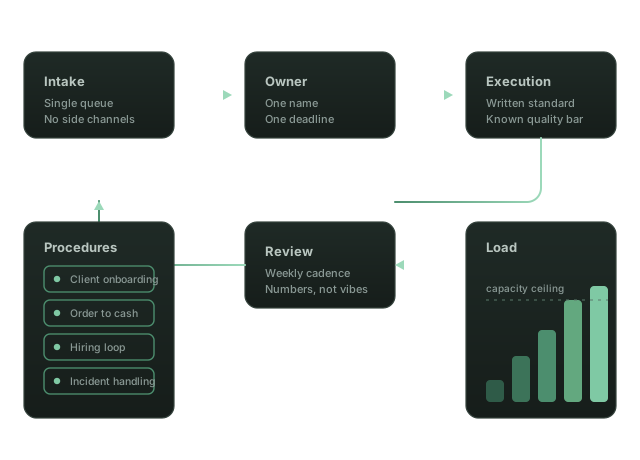
Every recurring piece of work in a company should be able to answer four questions: where does it enter, whose name is on it, what standard is it done to, and when does anybody look at it again. Most operational chaos turns out to be one of those four going unanswered for long enough that everyone stopped noticing.
We do not arrive with a framework to install on you. We spend the first stage watching the real thing instead, sitting in the meetings, reading the message threads where the exceptions get handled, and timing the handovers that people apologise for, which is why the map that comes out of it is one your team tends to recognise themselves in.
Both are invoiced half at the start and half on handover. Prices are in US dollars and they exclude travel, which is quoted at cost and agreed with you well in advance.
For owners who can tell that something is wrong but want it named and costed properly before committing to a rebuild.
Fixed fee. Three weeks from kickoff.
For companies that already know what the constraint is and want the system built, documented and handed over.
Fixed fee. Ten to twelve weeks. Diagnostic fee credited if taken first.
There is a six month minimum, after which it runs monthly with thirty days notice. All three tiers assume a system already exists, whether we built it or you did, so if there is nothing to maintain yet then it is better to start with the diagnostic instead.
A standing outside opinion, and somebody to hold the cadence when the week gets busy.
Around one day a week of attention.
Hands on the actual work, rather than only on the agenda for it.
Around two days a week of attention.
For a transition, a turnaround, or a stretch with no operations lead in place.
Around three days a week of attention.
Nothing we produce for you lives behind our login. Documents go into your document system, spreadsheets into your account and dashboards into whatever tool you are already paying for, so that if you stop working with us on a Friday, everything still opens perfectly well on the Monday.
It might be a post-acquisition integration, a founder stepping back, two divisions that need separating, or a new entity being set up to serve a group elsewhere. Describe it to us and we will price a scope against it in writing, within three working days of the intro call.
No, although we will push for it if the constraint is not already obvious, because building a system around the wrong bottleneck is an expensive way to feel productive. If you go on to take the Operating System Build within sixty days of a diagnostic with us, we credit the diagnostic fee against it.
During a diagnostic it is roughly an hour per person interviewed, plus a two hour findings session for your leadership team. During a build, expect two to four hours a week from whoever will own the system afterwards, and that involvement is genuinely not optional, because a procedure written without the person who does the work is fiction with a version number on it.
Only where a tool genuinely removes work, and usually rather later than clients expect us to, because most operations problems turn out to be ownership problems wearing a software costume. We take no commission, referral fee or kickback from any vendor, so a recommendation from us is worth exactly what it appears to be worth.
Then we will say so in the findings and you can point the ninety day sequence at demand instead, which does happen often enough to be worth mentioning. A company with clean delivery and no pipeline does not need a procedure library, it needs buyers, and the diagnostic is designed to be honest about which of the two you actually are.
After the six month minimum, yes. You get one pause of up to two months in any twelve month period, agreed in writing at least thirty days ahead of time. Anything beyond that counts as a cancellation, which is also perfectly fine and takes thirty days notice from the end of the current month.
Book forty five minutes and describe what keeps failing. We will tell you which of these engagements fits the problem, or that none of them really do.
We also run a much smaller trading mentorship covering risk and process discipline, which is education rather than advice. See what it covers.